‘The Problem Isn’t Talent. It’s the Structure.’
Music schools and cultural organizations are filled with capable professionals, including marketing teams. Yet many in‑house functions struggle to drive enrollment, ticket sales, donor engagement, and long‑term brand growth consistently. This is not usually due to lack of effort. It is a structural issue rooted in expectations without sufficient alignment, resources, or strategy.
Within music and arts organizations operating wholly in‑house, teams are often expected to carry strategy, execution, reporting, and cross‑department coordination at the same time. Without clear authority, dedicated resources, and shared goals, even strong teams spend most of their energy on reactive work.
Patterns like these show up frequently in music schools and cultural organizations with limited or isolated marketing structures.
🎳 Too Many Responsibilities, Not Enough Leverage
In many music schools, a single marketing lead is responsible for a wide range of work:
Enrollment and admissions campaigns
Email communication across students, families, donors, and alumni
Concert, recital, or season promotion
Website updates and content
Paid media (when budget allows)
Social media and community outreach
CRM maintenance and reporting
This operating model disperses focus instead of building momentum or cumulative growth.
A typical scenario might look like a private music academy launching a summer program after the budget and faculty schedules have been finalized. Marketing is brought in to “get the word out” with little runway for audience research, message testing, or channel planning. When enrollment underperforms, the issue is often attributed to marketing execution rather than structural constraints.
🚧 Misalignment Across Admissions, Development, and Marketing
In many music and cultural organizations, marketing is treated as a service function rather than a strategic partner. Each team has valid goals, but they often operate in silos without shared metrics or ownership of the audience journey.
Here is a graphic‑ready example of how this breakdown plays out:
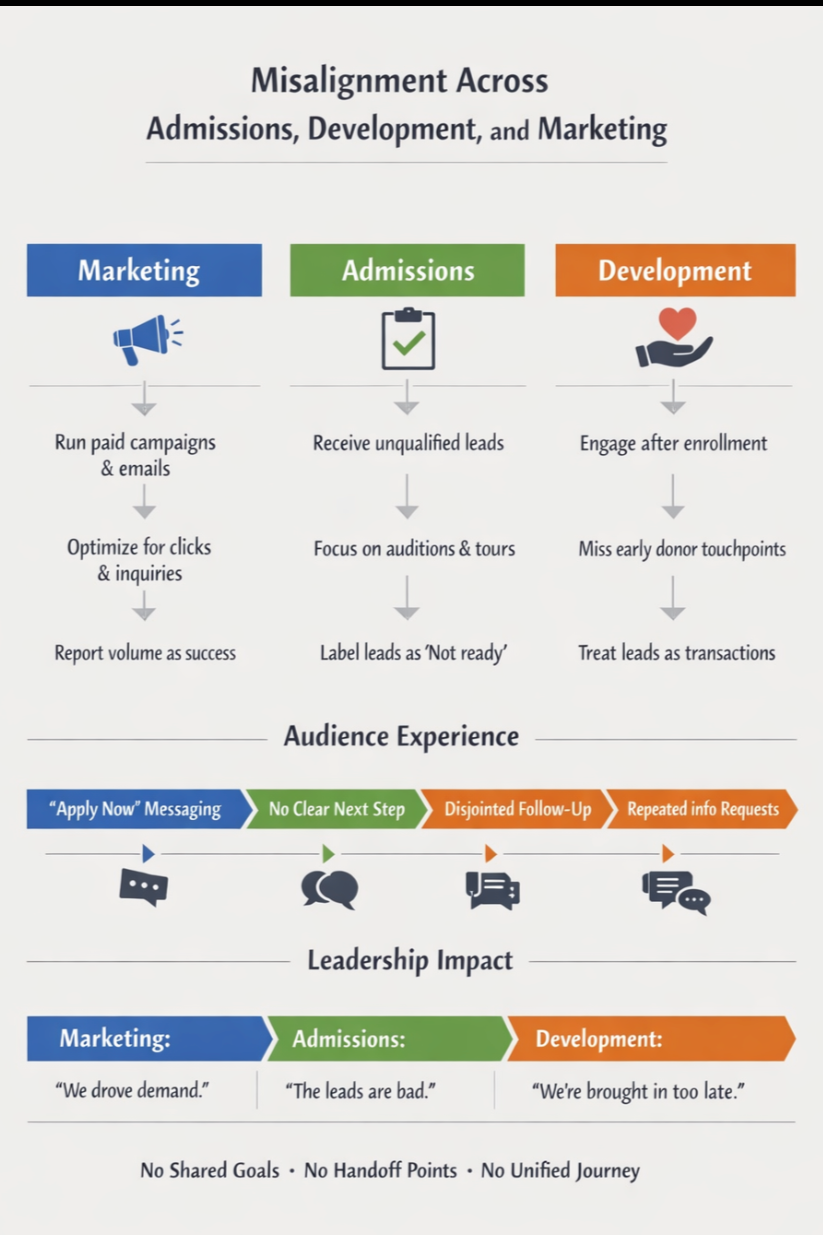
This is not a tooling problem. It is an operating model problem. Without shared goals and handoff points, individual efforts do not add up to audience understanding or business impact.
📖 Related Reading: Sales and Marketing Alignment Isn’t a Team Problem - It’s a Structural One
Short-Term Campaigns in a Long-Term Decision Cycle
Music schools and cultural organizations are real businesses with revenue targets, capacity limits, and sustainability needs. Decisions about families, students, and patrons take time and require continuity in messaging, nurturing, and value delivery.
Yet in wholly in‑house models, short‑term objectives often overshadow long‑term audience development:
Boost enrollment this semester
Sell tickets for the next performance
Drive applications before budget deadlines
Each of these goals is valid. The challenge is when they remain disconnected without shared strategy.
For example, a community orchestra may promote every concert as a standalone event. Messaging, visuals, and targeting reset each time, ignoring audience insights from previous efforts.
When treated strategically, each touchpoint can build on the last:
First‑time attendees can be guided toward repeat attendance
Families can be nurtured toward enrollment pathways
Donors can be engaged progressively through personalized stewardship
Programs that connect short‑term campaigns to longer journeys strengthen audience loyalty and expand sustainable revenue
And the beat goes on…
🧐The Overlooked Advantage: Music Organizations Are the Audience
One major asset often overlooked is that people inside music schools and cultural organizations already understand their audience deeply in musical terms. They know how students progress, what families value, and how artistic engagement evolves. The challenge is translating that insight into business systems.
Many organizations led by classically trained musicians excel at recognizing musical progression but struggle to apply the same pattern recognition to enrollment pathways, donor journeys, and audience retention systems. That translation gap weakens audience experiences and undermines growth even when demand exists.
As a result:
Initial points of contact are treated as endpoints
Continuation and upsell paths are inconsistent or invisible
Marketing, admissions, and instruction operate as separate experiences rather than a single journey
This is not a lack of sophistication.
It’s a translation gap between musical thinking and business structure.
When that bridge is missing, marketing becomes disconnected from how music education actually works—and growth stalls, even when demand exists.
🔎 Being Too Close to the Organization
In-house teams are deeply embedded in institutional culture, language, and priorities. While this brings valuable context, it can also make it difficult to see how the organization appears to prospective families, first-time patrons, or new donors.
This often shows up as:
Insider language that doesn’t resonate externally
Heavy emphasis on credentials instead of outcomes
Messaging shaped by internal pride rather than audience motivation
Without external perspective or structural distance, these blind spots persist.
💡Final Thought
Music schools and cultural organizations have a built-in superpower—their deep understanding of audiences—but without structured systems, that expertise often fails to drive consistent growth.
The UMM perspective is simple: recognize the gaps, connect short-term efforts to long-term audience development, and create systems that honor musical expertise while driving real results.
The next step is a hybrid approach that makes this superpower work harder.
📖 Continued Reading: How Arts Organizations Can Use ABM Principles To Strengthen Enrollment, Ticketing, Fundraising, and Partnerships
Written by Raycheal Proctor
Don't forget to schedule a time to discuss how UMM can help align your business for success.
Our team of experts is here to provide personalized guidance, tailored strategies, and innovative solutions to propel your business forward.
Dare to Dream, and Achieve Brilliance