Sales & Marketing Alignment

Sales and marketing alignment has been a business priority for a very long time. And yet, it remains one of the most persistent and expensive challenges organizations face.
Most teams don’t struggle because they lack communication, effort, or talent.They struggle because they’re operating inside systems that weren’t designed for alignment in the first place.
This is where many organizations begin to explore account-based approaches. But not as a campaign tactic, as a structural solution.
Why Alignment Breaks Down
In most organizations, misalignment shows up in familiar ways:
Marketing optimizes for leads; sales optimizes for revenue
Teams work from different definitions of success
Messaging diverges once prospects enter active conversations
Data lives in separate systems, interpreted differently by each team
These aren’t interpersonal issues. They’re operating-model issues.
When teams are structured around leads, channels, or isolated KPIs, alignment becomes reactive. They are dependent on meetings, handoffs, and good intentions.
That’s not sustainable at scale.
Alignment Works Best When the Account Is the Center
High-performing teams align more easily when they organize around a shared unit of value:The accounts or the target audiences.
This is why sales and marketing alignment is often the entry point into Account-Based Marketing (ABM), even when organizations don’t label it that way initially.
When teams shift from asking: “How many leads did we generate?” to: “Which accounts or target audiences are we trying to move forward and how?”
Alignment becomes operational instead of aspirational.
🏛️ The ABM Lens: Alignment as a System, Not a Meeting
Organizations operating through a sharp account-based and acutely targeted audience lens don’t rely on alignment as a cultural initiative. They design it into their workflows.
Here’s are the seven pillars of ABM we practice:
1. Shared Goals, Defined at the Account or Target Audience Level
Alignment starts with shared outcomes, not shared activity.
In account-based environments, sales and marketing align around:
Target account or audience progression
Pipeline velocity
Deal quality and expansion potential
This eliminates the false tradeoff between “marketing success” and “sales success.”If the account moves forward, the system works, and the TEAM is successful.
2. Unified Ideal Account/Audience Profiles (Not Just Personas)
Traditional alignment efforts often stop at buyer personas.Account-based teams go further.
They co-develop:
Ideal Account Profiles (IAPs / ICPs)
Decision-making teams/committee maps
Account/Audience level intent and fit criteria
This ensures marketing doesn’t just attract interest; it supports priority accounts sales actually wants to win.
📖 Related Reading: Identifying High-Value Accounts for your ABM Lists.
3. Account Selection as a Joint Decision
Alignment breaks down fastest when marketing and sales prioritize different accounts or audiences even when both teams are “right.”
This is especially common in music software and music education platforms, where audiences range from individual educators to large institutions.
Before: Parallel Targeting (Music Software Example)
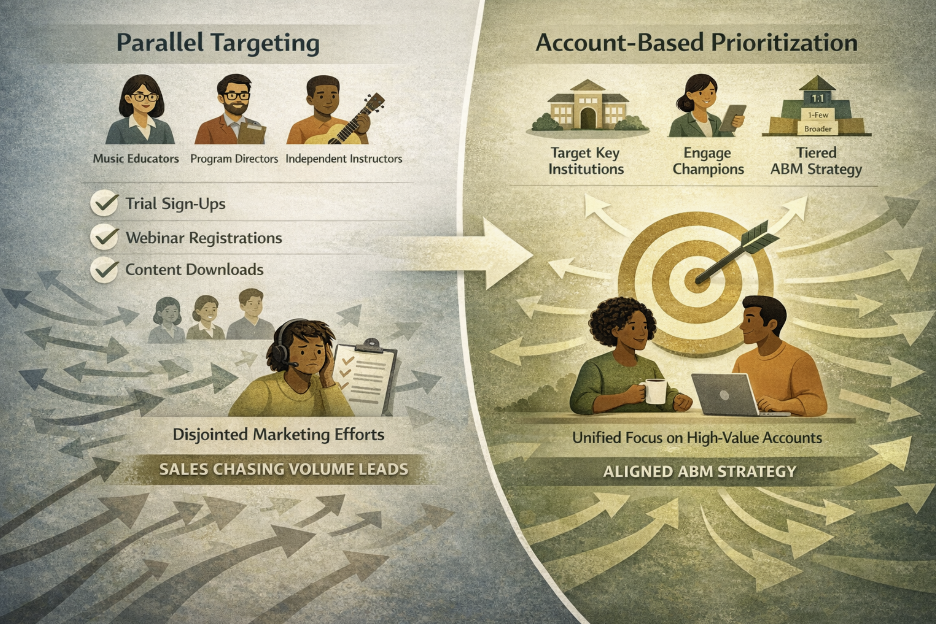
Marketing still drives awareness — but in service of accounts sales actually needs to win.
Targeting shifts from “Who might sign up?” to “Which organizations are we intentionally moving toward adoption or expansion?”
4. Messaging Built for Conversations, Not Campaigns
In aligned organizations, content isn’t created in isolation.
Marketing develops:
Account/audience-aware messaging
Sales-enablement content
Multi-touch narratives that evolve with the deal
Sales uses marketing not as a handoff — but as reinforcement.
The result: fewer disconnected touchpoints, more cohesive conversations.
5. Orchestrated Channels, Not Parallel Efforts
Alignment improves when teams stop running “marketing channels” and “sales outreach” separately.
Account-based execution coordinates:
Paid media
Email
Events
Sales outreach
Executive engagement
All in service of moving specific accounts forward, not maximizing isolated channel performance.
📖 Continued Reading: The Omnichannel Marketing Advantage for Arts Organizations
6. Shared Visibility Into Account Signals
Alignment requires more than shared goals, it requires shared context.
When teams see different slices of the same account, coordination breaks down quickly.
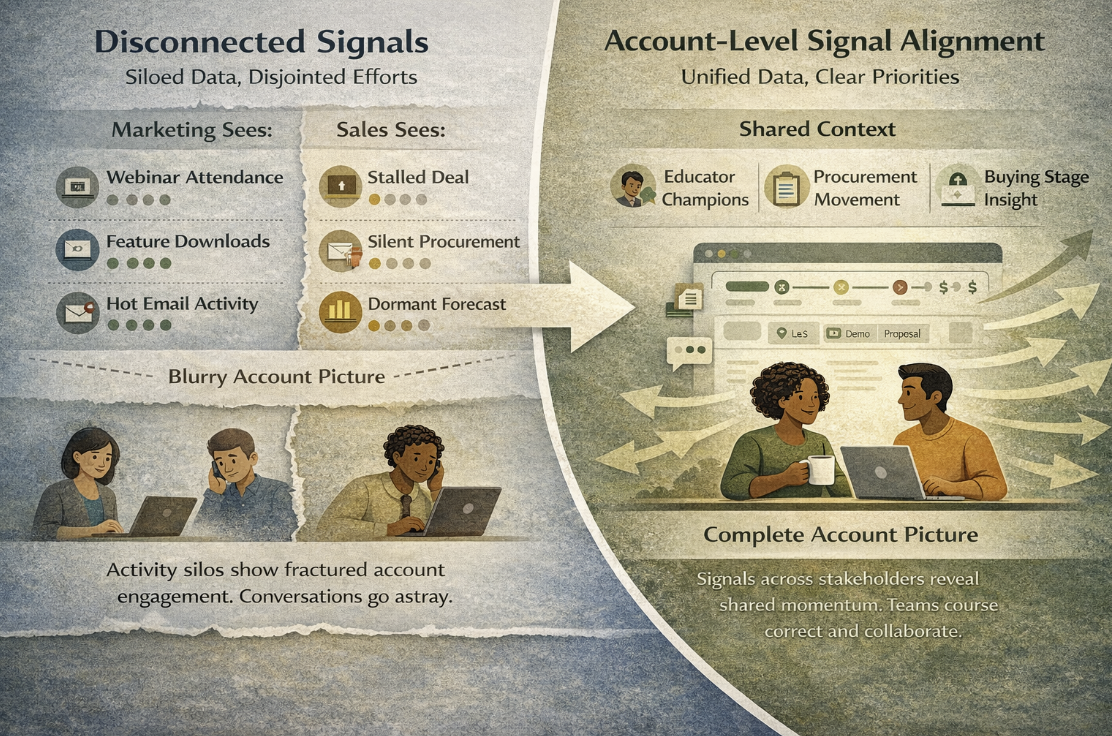
Before: Disconnected Signals
At a music software company:
Marketing sees:
Educators attending training webinars
Product feature downloads
Email engagement from instructors
Sales sees:
A stalled institutional deal
No recent replies from procurement
A quiet forecast
Both teams have data — but neither sees the full account picture. Outreach feels mistimed, and momentum gets misread.
After: Account-Level Signal Alignment
Aligned teams operate from a shared view of account engagement.
In this model:
Marketing activity shows which educators are actively using and advocating for the platform
Sales activity shows where the institution is in the buying or renewal cycle
Engagement signals are viewed across stakeholders, not in isolation
Instead of asking:
“Why isn’t this deal moving?”
Teams ask:
“Which signals suggest internal momentum, and how do we support it?”
Marketing reinforces adoption and internal buy-in. Sales advances the commercial conversation at the right moment.
That’s alignment driven by shared signals, not shared assumptions.
7. Metrics That Reflect Revenue Reality
Lead volume rarely explains pipeline performance.
Account-based alignment focuses on:
Account engagement
Opportunity creation
Deal acceleration
Expansion and lifetime value
When teams measure what actually drives revenue, alignment becomes easier to sustain.
Alignment Is the Symptom. Structure Is the Solution
Most organizations don’t fail at alignment because they don’t care. They fail because their systems weren’t built for it.
This is why many teams eventually move toward ABM - not as a marketing strategy, but as a go-to-market operating model that makes alignment inevitable instead of exhausting.
Just like deciding between agency vs. in-house (link:Marketing Agency vs. In-House: How B2B Leaders Should Decide in an Omnichannel World) isn’t about right or wrong - alignment isn’t about effort versus apathy.
It’s about structure.
What Comes Next
If this perspective resonates, the next step isn’t “doing ABM campaigns.”
It’s understanding:
How accounts/audiences are selected and tiered
How success is measured beyond leads
How omnichannel execution supports sales, not competes with it
That’s where ABM shifts from theory to execution.
And that’s where alignment finally stops being a problem to solve, and becomes the way your organization operates.
📖 Continued Reading: 7 Key Distinctions: Account-Based Marketing (ABM) vs. Demand Marketing
Written by Raycheal Proctor
Don't forget to schedule a time to discuss how UMM can help align your business for success.
Our team of experts is here to provide personalized guidance, tailored strategies, and innovative solutions to propel your business forward.
Dare to Dream, and Achieve Brilliance