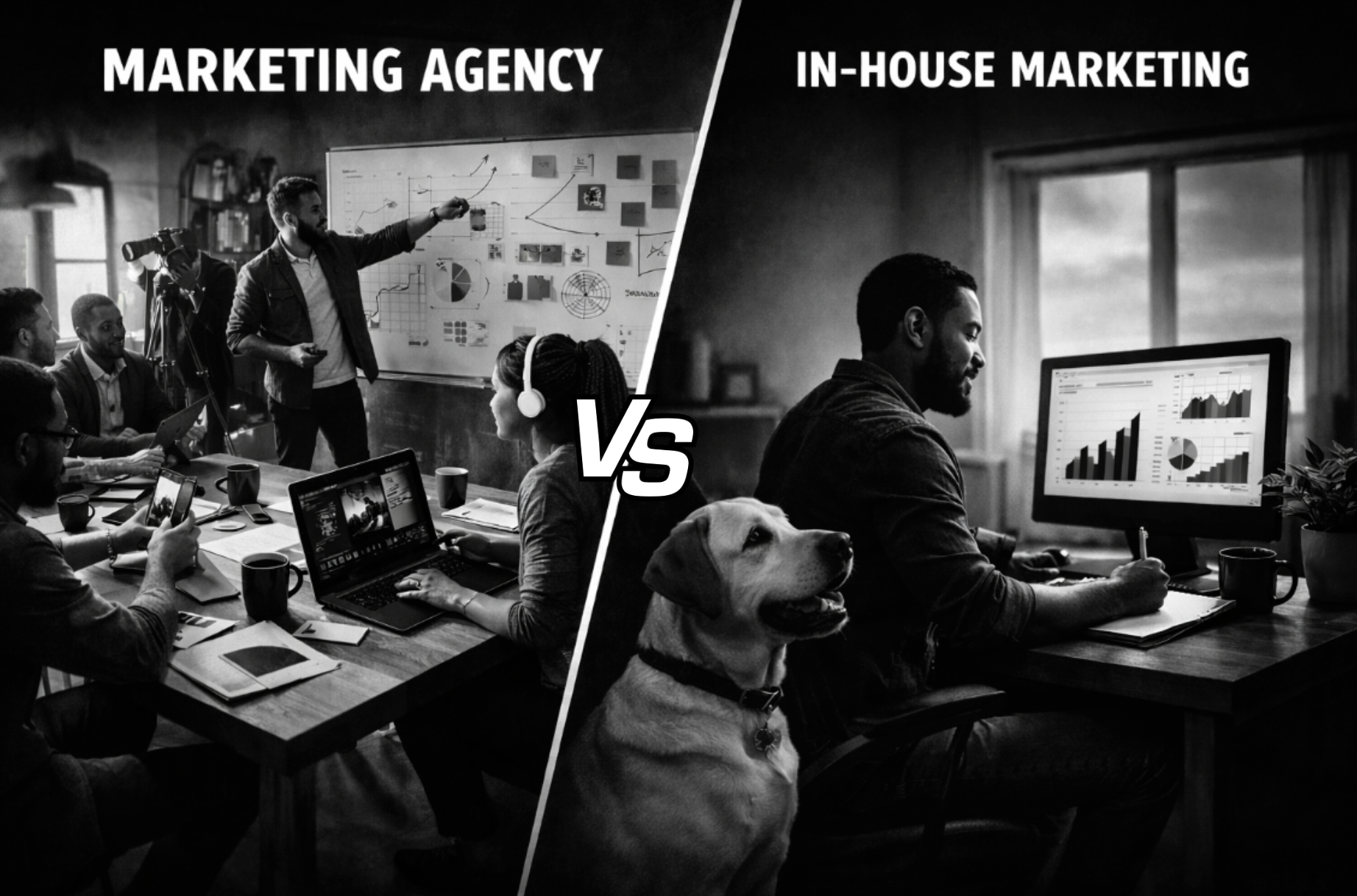
This Isn’t a Staffing Question.
For modern B2B organizations, marketing no longer lives in a single channel, team, or platform. Revenue growth depends on how well messaging, data, campaigns, and customer experience are orchestrated across touchpoints—from sales conversations and email to paid media, content, events, and post-sale engagement.
Against that backdrop, the decision to build an in-house marketing team or partner with an agency is not simply about cost or control. It’s about whether your organization can design, execute, and sustain an effective omnichannel strategy as complexity increases.
📖 Related reading: Omnichannel vs. Multichannel: Why the Difference Matters for B2B Growth
Let’s Discuss Expertise
🏠 In-House Teams
In-house teams tend to develop deep expertise in their business, customers, and industry. This contextual knowledge is invaluable when shaping brand voice, prioritizing initiatives, and navigating internal dynamics.
However, omnichannel execution requires more than channel familiarity. It requires specialists who understand how channels influence one another—how paid media informs content strategy, how email supports sales enablement, how CRM data feeds personalization, and how attribution works across the funnel.
Most in-house teams are forced to prioritize coverage over orchestration—especially as channel count increases.
🏛️ Agencies
Agencies are structured around repeated exposure to complex, multi-channel environments. Their strength lies in pattern recognition—seeing how channels work together across different organizations, industries, and growth stages.
The challenge is context. Without strong onboarding, documentation, and access to internal stakeholders, agencies can struggle to fully integrate into the client’s ecosystem.
🌿 Where Unlimited Mixed Marketing Fits
Unlimited Mixed Marketing was built specifically to bridge this gap.
Our team brings both in-house and agency experience, allowing us to design omnichannel strategies that account for internal realities while still applying external best practices.
Let’s Discuss Focus:
🏠 In-House Teams
In-house teams benefit from proximity. They can respond quickly, collaborate across departments, and maintain a singular focus on company priorities.
Yet omnichannel marketing exposes a common weakness: internal silos. Content, paid media, sales enablement, and lifecycle marketing often operate independently—even when housed under the same department resulting in fragmented messaging and inconsistent customer experiences.
🏛️ Agencies
Agencies bring structured focus. They are typically engaged to solve specific problems launch a campaign, improve pipeline quality, increase visibility and are less constrained by internal politics or legacy workflows.
This external objectivity is especially valuable in omnichannel environments, where alignment matters more than activity.
🌿 Where Unlimited Mixed Marketing Fits
We intentionally maintain a small, high-alignment client roster so we can focus on orchestration, not just output. Our role is to connect the dots—ensuring campaigns, channels, and teams are working toward shared outcomes rather than isolated metrics.
📖 Related reading: Sales and Marketing Alignment Isn’t a Team Problem. It’s a Structural One.
Let’s Discuss Resources & Technology:
🏠 In-House Teams
Internal teams control budgets, tools, and workflows, which supports long-term capability building. Over time, however, many organizations accumulate disconnected platforms—marketing automation, CRM, analytics, paid media tools—that are never fully integrated.
In omnichannel environments, misalignment between systems quickly undermines otherwise sound strategy.
🏛️ Agencies
Agencies often have access to advanced tools and established workflows, distributing overhead across multiple clients. This can accelerate execution—but only if those tools integrate cleanly with the client’s existing stack.
🌿 Where Unlimited Mixed Marketing Fits
UMM prioritizes system compatibility over tool accumulation.
📖 Related reading: 6 Things You Should Consider When Choosing Business Tools, Platforms, and Software
Before deploying platforms or campaigns, we assess how data flows between systems, how sales and marketing teams use that data, and whether the organization can sustain the setup long-term. Omnichannel success depends on integration, not volume.
Let’s Discuss Scaling: Headcount Growth vs. Elastic Omnichannel Execution
🏠 In-House Teams
Scaling in-house teams takes time. Hiring specialists, onboarding them into systems, and aligning them across channels slows momentum—particularly during periods of rapid growth or change.
Fixed overhead also reduces flexibility when priorities shift.
🏛️ Agencies
Agencies are designed for elasticity. Resources expand or contract based on need, allowing organizations to scale omnichannel efforts without permanent commitments.
The risk lies in continuity if strategy, documentation, and ownership are unclear.
🌿 Where Unlimited Mixed Marketing Fits
We combine agency agility with strategic continuity. Our engagements are designed to scale alongside your omnichannel maturity—supporting launches, pivots, and growth phases while maintaining consistency across channels and touchpoints.
Final Takeaway: Omnichannel Marketing Favors Intentional Hybrid Models
In an omnichannel world, marketing success depends less on where work is done and more on how well it is coordinated.
For most B2B organizations, the strongest model is not purely in-house or fully outsourced. It is a deliberate hybrid—pairing internal knowledge with external perspective, execution support, and strategic discipline.
Unlimited Mixed Marketing exists to support that model, helping organizations design omnichannel systems that scale without fragmentation.
📖 Continue Reading: How to Build an Omnichannel Marketing Strategy That Actually Works
Written by Raycheal Proctor
Don't forget to schedule a time to discuss how UMM can help align your business for success.
Our team of experts is here to provide personalized guidance, tailored strategies, and innovative solutions to propel your business forward.
Dare to Dream, and Achieve Brilliance